
Views: 0 Author: Site Editor Publish Time: 2026-11-17 Origin: Site


Scaling energy storage for commercial, industrial, or high-demand residential applications often hits a hard ceiling. You usually encounter major bottlenecks when relying on traditional low-voltage setups. These older configurations struggle heavily due to severe cable constraints, massive thermal loss, and strict footprint limits. To solve these issues, the industry is rapidly transitioning to high-voltage (HV) architectures. These modern setups offer an excellent solution for improving conversion efficiency. They also significantly reduce your physical space requirements.
Navigating this hardware shift requires a solid understanding of the underlying technology. This guide decodes the precise engineering behind these modern systems. We provide a clear, actionable framework for evaluating module configuration, capacity scaling, and installation realities before you begin procurement. By grasping these core concepts, you ensure your next energy storage deployment is highly resilient. You will also guarantee it operates at peak efficiency for years to come.
Efficiency Gains: Operating at higher voltages (typically 200V–800V+) reduces current, which minimizes thermal losses and allows for smaller-gauge wiring.
Architecture: A standard High Voltage Battery Rack System relies on a central High-Voltage Box and stacked battery modules governed by a Master/Slave Battery Management System (BMS).
Scalability: A Modular Battery Storage System allows for capacity expansion via series connections, but buyers must account for BMS compatibility limits and floor-loading constraints.
Procurement Lens: Safety certifications, thermal management strategies, and ease of installation are the primary differentiators between tier-1 and budget rack systems.
Understanding the hardware stack is critical for your project success. You must evaluate these components to predict maintenance costs and identify potential point-of-failure risks. A typical High Voltage Battery Rack System operates as an integrated ecosystem. Each component plays a specific, indispensable role in the overall operation.
Here is a detailed breakdown of the primary components you will encounter:
Battery Modules: These serve as the foundational building blocks of the rack. Manufacturers typically utilize Lithium Iron Phosphate (LiFePO4 or LFP) chemistry. LFP provides excellent thermal stability and a long cycle life.
High-Voltage Control Box (HV Box): This acts as the critical safety and control nexus. The HV Box contains the main contactors, pre-charge circuits, and industrial-grade fuses. It isolates the battery from the inverter during any fault conditions.
Master/Slave BMS: This system uses decentralized monitoring. Slave units sit inside each module to monitor individual cell voltages and temperatures. The Master unit aggregates this data and communicates directly with your hybrid inverter.
Rack Frame or Cabinet: This provides the structural housing. Engineers design these frames for specific seismic ratings. They also ensure proper cable routing pathways and maintain optimal airflow for passive cooling.
Common Mistake: Overlooking the BMS communication protocol. You must ensure the Master BMS speaks the exact same protocol as your chosen inverter. A mismatch here guarantees integration failure.
You might wonder why the industry is abandoning low-voltage (LV) systems for larger deployments. The answer lies directly in basic electrical physics. Understanding this shift helps you justify the initial capital expenditure.
Ohm’s Law explains this advantage practically. Power equals voltage multiplied by current (P = V × I). If you double the voltage, you instantly halve the current required for the exact same power output. Heat generation in a circuit follows the formula I²R (current squared times resistance). Slashing the current exponentially reduces these thermal losses. This keeps your system running cooler and preserves precious energy.
Lower current requirements completely eliminate the need for thick, expensive copper cabling. Routing massive 4/0 cables in a tight battery room frustrates installers and wastes time. High-voltage setups use much smaller-gauge wiring. This reduces your raw material expenses and dramatically cuts down on expensive installation labor.
Modern hybrid inverters operate using a high-voltage DC bus. High-Voltage Energy Storage systems align beautifully with this DC bus voltage. This alignment eliminates the need for heavy, inefficient step-up transformers. By removing this conversion step, you typically boost round-trip system efficiency by a solid 2% to 5%.
When must a project graduate from LV to HV? As a rule of thumb, you should transition to high voltage when your total capacity exceeds 20 to 30 kWh. You should also switch if your peak output requirements surpass the safe amperage limits of standard low-voltage inverters.
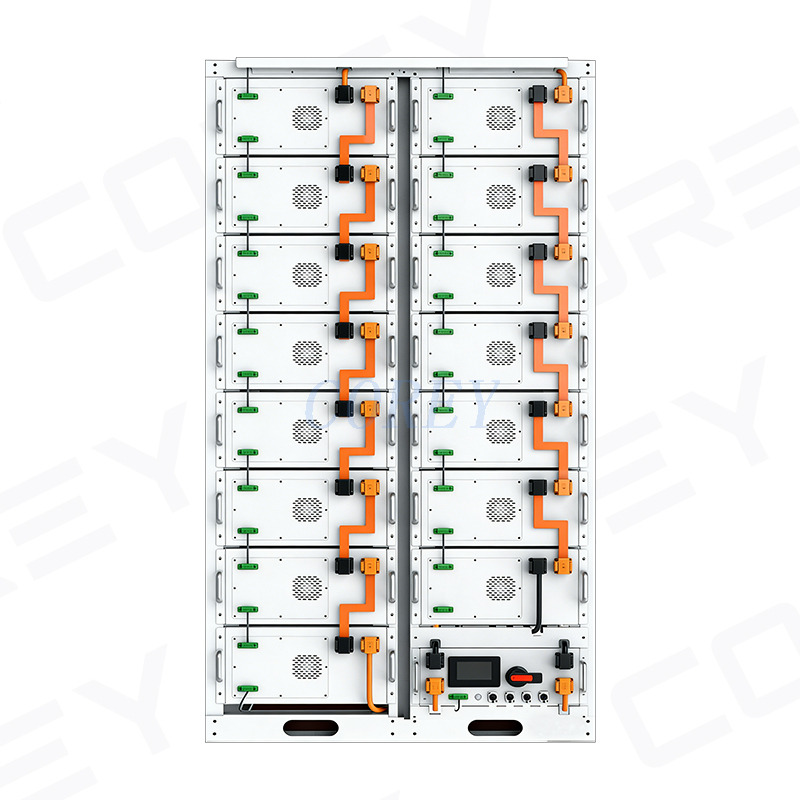
Configuring a rack requires precise mathematical alignment. You cannot simply stack batteries indiscriminately. You must follow strict rules for series and parallel connections.
When you connect modules in series, you increase the nominal voltage of the entire rack. However, the Amp-hour (Ah) rating remains exactly the same. For example, wiring five 51.2V 100Ah modules in series yields a 256V 100Ah system. Once a single rack reaches the desired voltage, you can parallel multiple identical racks together. Paralleling racks keeps the voltage stable but multiplies your total capacity (kWh).
Configuration Type | Impact on Voltage (V) | Impact on Capacity (Ah) | Primary Use Case |
|---|---|---|---|
Series (Module to Module) | Increases additively | Remains constant | Matching inverter start-up voltage |
Parallel (Rack to Rack) | Remains constant | Increases additively | Scaling total energy storage (kWh) |
You must always warn your design team against chasing "theoretical maximums." A Modular Battery Storage System sounds infinitely scalable, but real hardware has strict limits.
Inverter DC Input Limits: Your rack voltage must never exceed the maximum allowable DC input voltage of your hybrid inverter. Exceeding this will instantly fry the inverter hardware.
BMS Communication Limits: The Master BMS can only manage a specific number of Slave units. If the specification sheet says the limit is 15 modules, adding a 16th module breaks the monitoring loop.
Depth of Discharge (DoD) Realities: You must factor in usable capacity versus nominal capacity. If you buy a 50kWh rack but the manufacturer recommends an 80% DoD to preserve cycle life, you only have 40kWh of usable energy. Always size your system based on the usable metric to avoid under-sizing.
You need a reliable baseline to evaluate different vendor offerings. Examining an industry-standard model like the COREY-HV314R helps establish clear expectations. It sets a benchmark for physical dimensions, energy density, and cycle life.
When reviewing specification sheets, you must map raw features directly to tangible operational outcomes. Here are three critical metrics you should always benchmark:
Rack Density: You need to know how many kilowatt-hours fit into a single square meter of floor space. High-density racks reduce your real estate footprint. This becomes crucial in tight commercial utility rooms.
Plug-and-Play Connectors: Look for blind-mate or quick-connect terminals. Traditional bolted terminals require hours of tedious, dangerous wrench work. Quick connectors drastically reduce your installation hours, lowering your upfront labor costs.
Cycle Life and Warranty: Marketing materials often boast about 6,000 to 8,000 cycles. You must check how these cycle life claims align with commercial warranty terms. Verify the specific operational temperatures required to honor that warranty. If a 10-year warranty requires the room to stay exactly at 25°C, you must factor in continuous HVAC cooling costs.
Best Practice: Always request the battery degradation curve from the manufacturer. It shows you exactly how much capacity you will retain at year five and year ten.
Handling hundreds of volts of direct current introduces serious hazards. You must transparently address these dangers and enforce strict implementation protocols.
High-voltage DC poses severe arc flash and lethal shock risks. Unlike AC current, DC current does not cross a zero-voltage threshold. This makes a DC arc incredibly difficult to extinguish once it starts. The HV Box mitigates these risks by using specialized contactors and fast-acting fuses designed specifically to break DC arcs safely.
You cannot deploy commercial energy storage without strict regulatory compliance. Missing these certifications will void your commercial insurance and fail local fire codes.
UL 1973: The standard for stationary battery safety. It ensures the modules withstand physical abuse and electrical faults.
UL 9540 and UL 9540A: The gold standards for thermal runaway fire propagation. UL 9540A testing proves that if one cell catches fire, the entire rack will not explode simultaneously.
CE Certifications: Essential for European deployments, covering electromagnetic compatibility and baseline safety.
Your site readiness dictates your deployment success. Before moving a rack into a building, you must verify the floor weight-bearing limits. A fully loaded rack can easily weigh over 500 kilograms. Furthermore, indoor commercial installations require strict climate control requirements (HVAC). Extreme heat kills lithium batteries rapidly.
Finally, you must respect commissioning SOPs (Standard Operating Procedures). Your installers must complete precise firmware matching before flipping the breaker. They must also perform pre-charge validation. The pre-charge circuit slowly fills the inverter's capacitors to prevent a massive, destructive inrush of current upon startup.
Moving from technical research to active procurement requires a disciplined approach. Follow these three steps to narrow down your vendor list safely and effectively.
You must ensure the voltage window of the battery rack aligns perfectly with your inverter. Specifically, check the inverter's Maximum Power Point Tracking (MPPT) or battery input range. If the rack's fully charged voltage exceeds the inverter's upper limit, the system will trigger a hard fault and shut down entirely.
Do not judge a rack solely on its per-kWh module price. You must evaluate the broader capital expenditure (Capex) against tangible efficiency gains. Factor in the installation speed provided by quick-connect terminals. Calculate the reduced raw material costs achieved by using thinner cables. Also, account for the 2% to 5% boost in conversion efficiency. A slightly more expensive rack often pays for itself rapidly by drastically cutting your labor and cabling costs.
Hardware fails; it is an unavoidable reality. You must evaluate vendors based on their localized technical support footprint. If a BMS fails, can you get a replacement part in two days, or will it take two months? Assess replacement module availability. Furthermore, demand to see their integration manuals before purchasing. Clarity in documentation usually indicates a highly professional, reliable engineering team.
High-voltage rack systems transition modern energy storage from a cumbersome, cable-heavy deployment to a streamlined, highly efficient architecture. By moving to higher voltages, you reduce thermal losses, cut installation labor, and maximize your inverter efficiency.
However, you should maintain a healthy level of skepticism. While modularity offers excellent scalability, your system is only as robust as its BMS communication and thermal management design. Fancy enclosures mean nothing if the internal components cannot handle fault conditions or communicate flawlessly with the inverter.
Your next step is clear. Audit your current inverter specifications today. Alternatively, consult an integration engineer to map out your precise voltage and capacity requirements. Taking the time to calculate these metrics ensures you procure a resilient, high-performing asset for your facility.
A: The minimum number depends entirely on the start-up voltage of your paired hybrid inverter. Typically, you need at least 3 to 4 modules connected in series. This ensures the combined voltage crosses the inverter's minimum operational threshold so it can wake up and sync with the batteries.
A: You should avoid mixing old and new modules. Degraded batteries have higher internal resistance than fresh ones. If you place a new module in a series string with older modules, the BMS will throttle the entire rack to match the performance of the weakest, oldest module.
A: The module-level BMS only performs cell-level monitoring for voltage and temperature. The High-Voltage Box provides critical system-level circuit protection. It houses the heavy-duty contactors and fuses required to physically isolate the entire battery rack from the inverter during a catastrophic fault.
A: Extreme temperatures drastically impact performance. High ambient heat accelerates cell degradation and shortens cycle life. Cold temperatures can cause lithium plating during charging. You need robust ambient climate control to prevent system derating and to minimize harmful thermal variance across the stacked modules.


