
Views: 0 Author: Site Editor Publish Time: 2026-11-08 Origin: Site


Thermal management dictates the beating heart of modern energy grids. Without precise temperature control, even the most advanced lithium-ion cells degrade rapidly. They may even face catastrophic failure. Industry demands have outgrown legacy cooling methods. Facility managers now face a massive shift. They must move from traditional setups to high-density solutions to meet aggressive load profiles.
Choosing the wrong thermal strategy severely compromises system safety. It impacts lifecycle longevity and overall return on investment. We will explore the technical mechanics behind both major cooling technologies. You will gain a practical framework for evaluating options.
This guide aligns best with your specific operational requirements. By the end, you will understand exactly how thermal stability drives performance. You can confidently optimize your commercial energy storage deployments.
Performance Density: Liquid-cooled systems allow for higher energy density, critical for modern 233kWh cabinet configurations.
Operational Longevity: Superior heat dissipation in liquid-cooled BESS directly correlates to reduced cell degradation and lower O&M costs over 10+ years.
Safety Thresholds: How thermal runaway mitigation differs between the two methods and the impact on site certification (e.g., UL 9540A).
Strategic Fit: Guidance on when air cooling remains viable vs. when the technical demands of C&I projects necessitate a transition to liquid cooling.
Air cooling relies on forced convection to remove heat. Fans push ambient air through battery racks and modules. The air absorbs heat from the cells and exhausts it outside. This method is structurally simple. It involves fewer moving parts and carries zero risk of liquid leaks.
However, air cooling has strict physical limitations. Air possesses a low specific heat capacity. It cannot absorb thermal energy quickly. Performance depends heavily on ambient room temperature. If the facility gets too hot, cooling efficiency drops dramatically. Dense pack architectures restrict airflow pathways. This restriction creates dangerous hot spots deep inside the battery arrays.
Liquid cooling takes a fundamentally different approach. It uses thermal conduction via indirect contact. A dedicated Liquid Cooling Battery Energy Storage System utilizes cold plates. These plates sit directly against the battery modules. A coolant mixture circulates through micro-channels within these plates.
The fluid absorbs heat rapidly. It then travels through a closed-loop system to a heat exchanger or chiller. Liquid holds significantly more heat capacity than air. This allows the system to extract massive amounts of thermal energy instantly. Coolant flow rates can adjust dynamically based on real-time cell temperatures. This closed-loop efficiency guarantees stable conditions regardless of outside weather.
Commercial energy demands continue to rise. Real estate footprint constraints force manufacturers to pack more power into smaller enclosures. A modern C&I BESS Cabinet operates with minimal internal airspace. You simply cannot fit massive HVAC ducts into these compact units.
Higher energy density requires aggressive heat management. Cells packed tightly generate concentrated thermal loads. Without rapid heat extraction, individual modules drift out of balance. Maintaining a stable State of Charge (SoC) balance across all modules becomes impossible. Liquid cooling solves this space constraint. It provides superior heat extraction within a fraction of the physical volume.
Temperature variance between cells defines system health. We refer to this variance as Delta-T. High Delta-T causes uneven cell degradation. Some cells age faster than others. This imbalance degrades the entire battery string capacity.
Air cooling struggles to maintain uniformity. Cells near the fan receive cold air first. Cells at the back receive pre-heated air. This dynamic often results in a Delta-T exceeding 5°C. Liquid cooling minimizes this variance. Coolant flows evenly across precisely engineered cold plates. A Liquid-Cooled BESS reliably keeps temperature variance under 3°C. This uniformity dramatically extends the functional lifespan of the lithium-ion cells.
Cooling efficiency directly dictates system availability. Battery management systems (BMS) actively monitor temperatures. If a battery gets too hot, the BMS triggers a thermal derating protocol. The system throttles power output to prevent damage.
Higher thermal stability prevents these artificial bottlenecks. Liquid cooling allows for faster charging and discharging. You can execute aggressive duty cycles without hitting thermal limits. This capability proves essential for high-frequency frequency regulation or intense peak-shaving applications. Better cooling ensures your asset remains available when grid pricing peaks.
Cooling systems require electricity to operate. We measure this efficiency using Power Usage Effectiveness (PUE). In high-ambient-heat environments, air conditioning units work constantly. HVAC compressors draw massive auxiliary loads just to treat the incoming air.
Liquid cooling pumps consume far less energy than massive industrial fans and HVAC compressors. Fluid moves heat more efficiently per watt of auxiliary power consumed. This lower parasitic load means you keep more generated power for commercial use.
Performance Metric | Air-Cooled Systems | Liquid-Cooled Systems |
|---|---|---|
Typical Cell Delta-T (ΔT) | 5°C or higher | Under 3°C |
Heat Extraction Efficiency | Low (Relies on air volume) | High (Direct conduction) |
Auxiliary Power Load (PUE) | High in hot climates | Consistently low |
Energy Density Capability | Low to Medium | Very High |
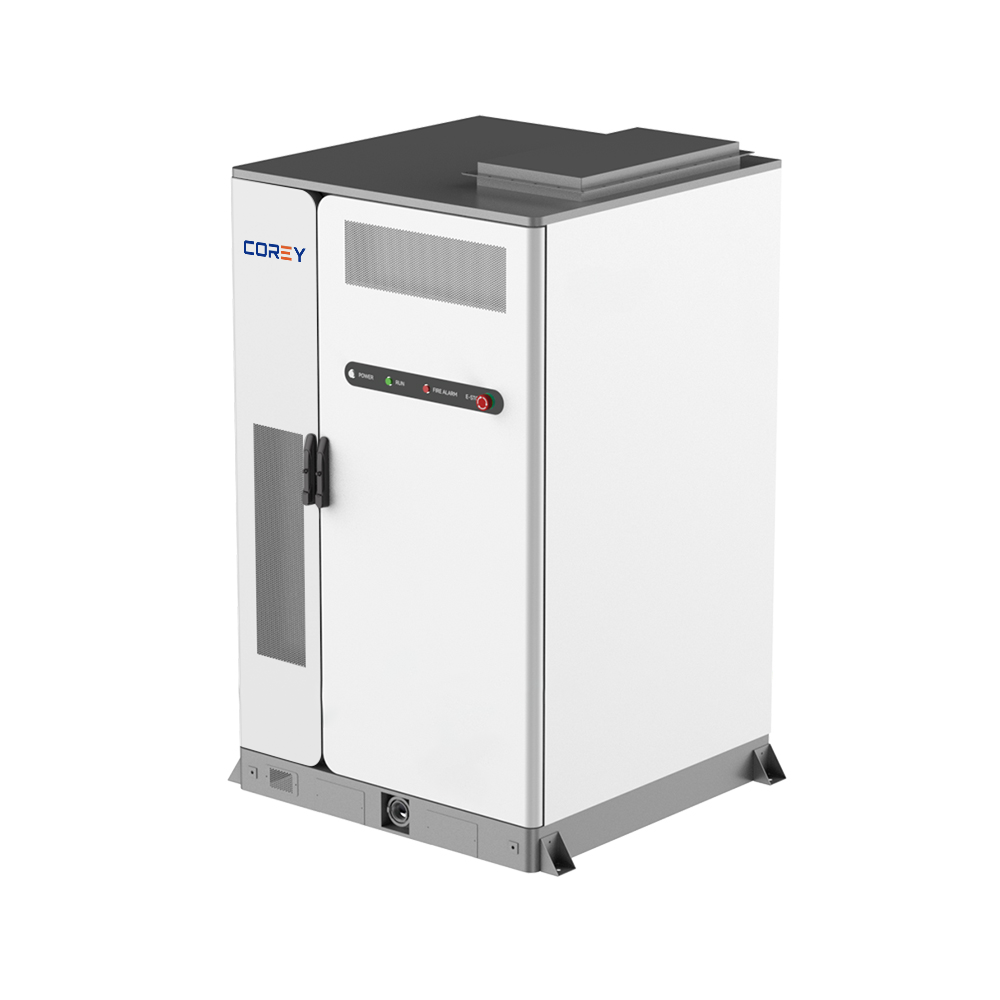
Thermal runaway presents the highest risk in battery storage. One failing cell generates intense heat. This heat triggers neighboring cells to fail. The result becomes a dangerous cascading fire.
Liquid cooling serves as an active suppression barrier. The cold plates separate module rows physically and thermally. If a single cell overheats, the flowing liquid acts as a heat sink. It extracts the dangerous thermal energy before it transfers to adjacent cells. Air cooling simply blows hot air around, which can accidentally accelerate the propagation of a fire.
Outdoor deployments face harsh environmental realities. Desert sites endure blistering sun and dust. Coastal settings deal with salt fog and high humidity. Equipment must survive these conditions without failing.
Liquid-cooled enclosures typically achieve IP65 ratings. The cabinet remains completely sealed against the outside environment. No outside air enters the battery compartment. Air-cooled systems often peak at IP54. They must pull outside air through filters. Sand, moisture, and debris eventually bypass these filters. Over time, internal contamination degrades the battery terminals and control boards.
Regulatory bodies scrutinize energy storage safety closely. The UL 9540A standard evaluates thermal runaway fire propagation. Passing these stringent tests determines your project viability.
Insurance carriers now heavily favor liquid-cooled architectures. Their localized heat suppression limits catastrophic damage during failures. Municipal fire marshals also prefer sealed liquid systems for indoor deployments. Adopting this technology streamlines site permitting. It often results in lower insurance premiums due to a statistically safer risk profile.
Project managers often hesitate at the upfront costs. Liquid-cooled hardware carries a higher Capital Expenditure (CAPEX). You must purchase pumps, manifolds, and specialized cold plates.
However, the initial premium quickly offsets during operations. Operating Expenses (OPEX) remain significantly lower. You spend less on auxiliary cooling electricity. More importantly, precise temperature control extends battery cell life. Preventing premature degradation means you avoid early module replacements. This long-term operational savings dwarfs the initial hardware price difference.
Every thermal strategy requires ongoing maintenance. Understanding these tasks helps you build realistic service budgets.
Air Cooling Maintenance: Technicians must replace air filters regularly. They must clean HVAC condenser coils to maintain airflow. Fan bearings require periodic inspection. Filter negligence leads directly to system overheating.
Liquid Cooling Maintenance: This involves fluid management. Technicians monitor coolant pressure to detect micro-leaks. They check pump seals annually. Every few years, you must flush and replace the glycol mixture to prevent internal scaling.
Monitoring Systems: Both systems utilize digital sensors. Liquid systems include advanced leak detection cables. These sensors trigger automatic shutdowns if moisture appears.
Energy storage projects run for a decade or more. Selecting the right cooling technology today determines your repowering flexibility tomorrow. Battery chemistry evolves rapidly. Future module replacements will feature even higher energy densities.
Legacy air-cooled cabinets cannot handle next-generation thermal loads. Upgrading them requires a complete cabinet tear-down. Conversely, a liquid-cooled 233kWh Energy Storage System offers excellent forward compatibility. You can swap in denser battery modules later. The existing pump and chiller infrastructure simply adjusts flow rates to accommodate the new thermal profile.
You must map your specific project needs against cooling capabilities. Start by analyzing your site location. What is the peak summer ambient temperature? Next, evaluate your charge and discharge intensity. Frequent cycling generates massive heat.
Low-intensity solar shifting in a mild climate might survive on air cooling. Aggressive frequency regulation in a desert environment demands liquid cooling. You must also weigh local noise ordinances. Liquid systems run much quieter than industrial HVAC fans.
Use this checklist to refine your procurement strategy. Cross-reference your operational goals with hardware realities.
Target power rating and specific cabinet configuration.
Site-specific thermal constraints and ambient weather extremes.
Available physical footprint for the installation.
Maintenance budget allocations for the next ten years.
Technical capabilities of local service partners regarding fluid systems.
Required safety certifications (like UL 9540A) for local permitting.
Do not rely solely on generic performance curves. Every deployment site has unique variables. Your best action involves engaging directly with manufacturers early in the planning phase.
Request site-specific thermal modeling. Provide them with your expected load profile and local weather data. Manufacturers can simulate how their cooling system will perform under your exact conditions. This data-driven approach removes guesswork. It ensures you select the optimal hardware for your operational goals.
Air cooling still maintains a place for low-intensity applications. Distributed systems in moderate climates can leverage its simplicity. However, liquid cooling stands firmly as the technical baseline for modern deployments. High-performance C&I projects simply generate too much heat for air convection to manage effectively.
We must prioritize long-term asset reliability over initial hardware savings. Superior temperature uniformity protects your lithium-ion investment. Active thermal suppression ensures facility safety and eases regulatory compliance. Sealed enclosures guarantee performance despite harsh environmental conditions.
Transitioning to liquid cooling prepares your facility for the future. Evaluate your next project using detailed thermal modeling. Choose a strategy that protects your cells, lowers your operating expenses, and maximizes your system availability.
A: No. While the initial equipment costs more, liquid cooling generally costs less to operate. It uses smaller pumps instead of large, power-hungry HVAC compressors. The auxiliary power draw remains lower. Additionally, precise temperature control extends battery life, saving massive replacement costs over the system's lifespan.
A: It is highly difficult. A modern 233kWh system features extreme energy density packed into a small cabinet. Air cooling cannot efficiently extract heat from the deep, dense center of these module arrays. Liquid cooling is essentially required to manage this density safely.
A: Routine inspections occur annually. Technicians check pump health, verify seal integrity, and monitor coolant pressure. A full coolant flush and replacement typically happens every 3 to 5 years, depending on the manufacturer's specific glycol blend and operating temperatures.
A: Modern designs minimize this risk effectively. Manufacturers use non-conductive coolants and robust, aerospace-grade seals. Cabinets feature integrated moisture sensors and leak detection cables. If a micro-leak occurs, the system immediately shuts down and alerts operators long before a short circuit can happen.


